3/14/2013

25 Hours on a Bus

5 minutes in: We meet a friendly fellow traveler--another American. We compare stories and towns and favorite books. It's nice to have someone new to talk to. Maybe this bus ride won't be so bad.

30 minutes in: The scenery is lovely. Mountains surround us, and the double-decker bus seems so small in comparison. We're in the front row, and it's like watching a movie on the big screen, with no tall heads blocking our view of  the moving pictures. Tom reminds me that while the front row seat has the best views, we're also the first ones out the window if we crash. Yikes.

1 hour in: We get trays with big lunches. Ham and cheese sandwiches, rice, dessert, and beef and potatoes. Looks good. Tastes terrible. I pick at mine and save the condiments and utensils. I feel thrifty and travel-smart-- it's like stealing little bottles of shampoo and pens from hotel rooms.

2 1/2 hours in: We make our first stop. It's a tiny little town, and it looks like life barely exists here. I wonder if the half hour we sit at the bus terminal counts towards the 22 1/5 hours we have left. I hope so.

3 hours in: Lovely. A Cameron Diaz movie. It looks terrible, so I bury myself in a book and try to tune out the stupid noises. It's hard to do when Ashton Kutcher keeps screaming "Vegas!"

4 hours in: The landscape has changed. Instead of mountains, we have flat, flat land. It's all barren, with little bushes and desert plants. Everything is the color of corn-silk or dusty brown. In the distance, we can see lightning striking and mountains, but the big screen is on a wild west loop.

6 hours in: I'm officially ready to get off of the bus. 19 hours to go. 

7 hours in: We're stopped in the middle of the desert, and our bus is boarded by some Argentinian military officials. They search the bus, but apparently they didn't find what they were looking for. We keep driving. This desert is eternal.

8 1/2 hours in: The plastic knife I "stole" this morning has already come in handy since we left our pocket knife in our luggage under the bus. Plastic knives aren't the best at cutting cheese and chorizo. The knife snapped in half, but still works.

10 hours in: We drive by a beautiful, long lake. It's a little eerie. I think it's the first time I've seen a lake this big without any development around it. I feel like we're explorers who've discovered something new. I hope it stays this way.

11 hours in: Who picked the movies for this bus ride? They're all dark and violent. The movies are hard to hear because of the Muzak playing downstairs, but it's kind of amusing to watch Taken with the song Girls Just Want to Have Fun playing in the background.

12 hours in: We make it to the ocean. The city is bustling, and there's a lot more energy here than in the languid mountain towns. It feels funny after such a long journey in the desert. We stop so the bus company can load dinner onto the bus. The look of the lasagna is... unpleasant. Tom devours his. I eat a plum and some bread and cheese instead. 

14 hours in: Trying to sleep. My neck is bent funny and the bus is freezing cold. 

18 hours in: I slept. Where's my blanket?

21 hours in: Our breakfast is delivered. Crackers and jam. For some reason, breakfast comes with a little chocolate cupcake. It's delicious, though not the best way to kick off the day. I supplement it with a banana and some cheese from our rations. 

22 hours in: Another nap, and chit chat with the girl next to us. We try to pick out animals in the desert. We've found a bunch of sheep, some llamas, and neat looking birds. I see a mini-ostrich, but no one else does. Maybe I'm dreaming again.

24 hours in: A glimmer of mountains in the distance. They still look small, though, so we must still have a ways to go.

25 hours in: We're driving through a tiny little village. Tom remarks that one day, this tiny little village may turn into a big town. I laugh, and then our bus slows. And then we notice the bus terminal. 

-R

3/11/2013

El Pitriquitrón

The town of El Bolsón is surrounded by what seems like a hundred different peaks. Jagged ridge-lines overlook the town, and snow-covered peaks loom in the distance. It's impossible not to be awed.

We've spent much of our week in El Bolsón climbing up some of the smaller mountains. We visited the Cabeza de Indio (Indian Head), which looks like a man's face carved into the mountain (similar to New Hampshire's Old Man in the Mountain). Cerro Amigo (Friendly Mountain) was a quick 30 minute hike up; we almost felt like we didn't deserve to see the awesome views of the mountains and town below.

We decided to ask the local experts about the best hike in the entire town. Their answer? "Todos" (all). Hmm. "So what's the best of the best?" 

And they pointed 2,284 meters into the sky to here:


"Cool," we said. "What's it called?"

"El Pitriquitrón."

"And where's the trail?"

"That way." Pointing.

So that's where we decided to hike that day.

Tom pointing to the wrong mountain.

We ventured out on Monday, in the late afternoon.

3/06/2013

Food on the Road: Black Bean Soup

We've only been traveling for a few weeks, but we've already learned that food on the road is a bit of a balancing act. It's much easier to eat meals out at a restaurant, and it's a neat way to get a feel for a culture and it's cuisine. But it's also expensive, and not the healthiest way to live!

To keep our costs (and health) in control, we're trying to cook a few meals each week. Thankfully, most hostels have kitchens available for guests to use. Often they're not the fanciest of kitchens (they often lack any kind of sophisticated cooking tools like, say, ovens or blenders), but they usually have the basic tools we need to make a meal for ourselves.

We're trying to make the most of our "hostel-cooked" meals. Ideally, our meals will be:

1. Filling. Tom gets cranky when he's hungry.
2. Relatively healthy. Right now we're in the land of (amazing) beef and red wine, so ideally these meals will give usa dose or two of veggies.
3. Inexpensive.
4. Simple and pretty quick to make. We don't want to spend our whole trip sitting in a kitchen!

We'd also like to make use of leftovers, so that we don't waste food and we don't have to lug ingredients around the world!

So, with that overly-thorough introduction, here's our first recipe:

   Black Bean Soup
  
Black bean soup. Served with wine.

   Ingredients:

   4 cloves garlic, minced
   1 onion (small), chopped
   1/2 red pepper, chopped
   1/2 green pepper, chopped
   1 carrot, chopped
   2 tablespoons of cumin (or, to taste)
   2 tablespoons of olive oil
   Small chunk of beef
   Black beans (about half a bag)
   Diced tomatos (half a can)
   2 bullion cubes

   For garnish:

   1 avocado
   Bunch of greens (I think we used arugula)
   Sour cream or yogurt (we used Doble Crema, and we're still  not sure what it is!)

   Directions:

   Step 1 - Soak the beans for a long time (we soaked them for about 24 hours.) Then, boil the beans in a pot of water with the two bullion cubes (we used enough water to cover the beans, plus another inch or so.)

   Step 2 - While the beans are boiling, chop up all of the vegetables. Saute them in a small pot with olive oil and a bit of cumin.

   Step 3 - Cut up the beef into bite-sized pieces, then brown them in a small pan.

   Step 4 - Once the beans are soft enough to eat, add in the vegetables, beef and tomatoes. Simmer 5-10 minutes, then serve. Add garnish to taste. 

This meal was a perfect conclusion to a long day of hiking in sprinkling rain. The hike was gorgeous, but the cool, damp air left us craving a warm fire and a big bowl of stew. This definitely fit the bill. And, it hit all of our four requirements.

Tom, chowing down.
We'll definitely make some version of this stew again. It's pretty inexpensive and easy to make. It doesn't need any fancy equipment-- the only thing it needs is time. 

Share some recipes with us in the comments! And if you have any ideas on how to make this recipe tastier, cheaper or easier, please let us know!

-R

3/04/2013

El Bolsón, Argentina


Two hours South of Bariloche along Route 40 is the town of El Bolsón where Butch Cassidy and the Sundance Kid lived for a few years in the early 1900's and where hippies flocked in the 1970's to bask in the positive ions that purportedly emanate from surrounding peaks. The town has only a few paved roads, but the park in the center is enormous. Three times a week the half-moon street of the park invites the locals to set up shop and sell their goods. Everything is hand-made, from cutting boards to lucky gnome dolls to wheels of cheese.

A local artisan making a bowl in the shape of a leaf

A blurry shot of Rachel dancing in the streets on the night of our arrival

We stayed at Hostel Pehuenia, and we highly recommend it for anyone passing through the area. The couple that runs the hostel live in the house and have two kids, dogs, and plum trees in the backyard which they use to make the jams for breakfast. They were extremely nice and accommodating.


Our Hostel

And here is a dog that lives at the hostel. He is a riot. I never actually saw him in any other position but this.


On a rainy day, the hostel owner took us for a ride and told us the history of his town.  Despite the rain, we decided to get out on a mountain peak and walk around a bit instead of driving home. Up the hill a short way was a rock face that the locals call the Head of the Indian. After that, we tried looking for the Hidden Waterfall. That waterfall was pretty well hidden, too, because we got lost. To our credit, the only signs we saw were arrows on trees that pointed in both directions. Knowing the direction from which we'd come, we always chose the opposite... and headed two hours in the wrong direction.

Here are some pictures from that very wet day:

Clearly marked trails...


Rachel with the Indian Head in the background


Finally, at the end of the day, a sign...


Originally, we were only going to stay in town for three nights, but we enjoyed it so much and met such nice people that we stayed for a week. Our next part of the trip was Cerro Piltriquitron, a two-day hike to a 2,284 meter summit that looks down not only on El Bolsón, but on the surrounding mountains of both Argentina and Chile. The views were incredible.

More on that later, though.

Cheers,
Tom

2/26/2013

Food on the Road: Bariloche

Bariloche is a nature-lover's heaven... but if you love ice cream, or chocolate or steak, it's your heaven too.

When we were hanging out in Chile, we talked to a British couple who had just come from Bariloche. They raved about Bariloche's food, and gave us a long list of places we needed to check out while we were in town. Once we got to our hostel (the great La Barraca Suites), we wanted to confirm these rumors, so asked them the three most important questions:

 1. Where can we get the best steak in town?     
 2. What is your favorite ice cream shop?      
 3. Is there a place where we can get amazing chocolate?

Interestingly, our hosts confirmed the locations we'd heard from our British friends, so we set out to enjoy all of the deliciousness.

Waiting in line at Albertos
After our long journey into the woods, we decided we were in great need of a hefty piece of steak. The steak at El Boliche de Albertos was supposed to be the biggest and best piece of meat in town. We got there before the place opened, at 7:50pm. (In Argentina, people eat dinner closer to 9 or 10pm... much later than we can handle!) It's a good thing we got there early; there was a line halfway down the block! Thankfully, we got the 2nd to last table available in the place. The restaurant itself was pretty neat. We were able to walk around and see the guys cooking all of the steaks on huge grill. But, as these things often go, the quality of the food wasn't quite up to the hype. The steaks were huge and delicious, but not nearly as awesome as we'd expected. That didn't stop us from devouring them entirely.

Steak, Malbec and tons of fries
Tom and the remains of his steak

Grill master at work


 We'd also heard great things about Juaja, an Argentinian ice cream shop. We love ice cream, and we love trying out local "cuisine," so we made sure to stop at Juaja two times during our trip to Bariloche. You know, just to be sure we got a good feel for the "menu." We were not disappointed. I think they had something like a dozen different kinds of chocolate ice cream, plus dozens of fruity, cream, and other flavors. My favorite was the Calafate flavor, which was made from a wild Patagonian fruit. [Update: Tiramisu was better.] While the Juaja ice cream was delicious, my vote still goes to the gelato we got in Santiago, where the mint ice cream tasted like the mint had been freshly plucked from someone's backyard. (Sorry guys, can't remember the name... it'll have to remain a secret spot, for now.)

The cones are huge!

Hot chocolate from Jauja's on a day when it was too chilly for ice cream

Ice cream!

And on our last day in town, we realized we hadn't found any of Bariloche's legendary chocolate. [Bariloche was settled by a number of Swiss and German settlers who, thankfully, brought with them incredible chocolate-making abilities.] We headed to Mamushka, one of about a dozen chocolate shops in town. The whole store smells like chocolate, and it's always bustling with people. We decided to suck it up and spend the $12 for chocolates, knowing that we'd regret it if we didn't splurge a little. And... oh man. Mamushka makes the best chocolate I've ever had. It's gooey. And rich. If I could have a piece of this chocolate every day for the rest of my life, I'd live to be 182.


Me, with chocolate

Mmmm

Happy eating!

-R

2/25/2013

Camping and Our Second Hike

After our first hike up Cerro Catedral, we limped back to Bariloche and claimed a small area of a campsite called La Selva Negra. It was a perfect place, right off the bus route, not far from town, spacious, quiet, and with Wi-Fi!


We love camping, but being so far from home and our supply of gear, there were a few problems: 1) Mosquitoes, 2) No pots for cooking, 3) High, high up on the hillside (especially for sore legs), and 4) The freezing cold.

That last problem was the worst. See, we didn't really pack for very cold weather. Since we're backpacking mostly through cities and towns, it isn't very efficient to carry all the necessary cold weather camping gear. We'll rent gear in Patagonia when we need it, and we have sleeping bags and mats to keep us off of the ground, but our stuff is for, say, Europe in summer, the beaches of Greece, etc. We didn't think this would be a problem in Bariloche since the days were 65F and sunny... but we were wrong.

I really suffered that night at the campsite. Nothing terrible and nothing life-threatening, but it was cold enough that we didn't sleep very well. We pulled out the emergency blanket and draped it over us in the middle of the night. If you've ever used one before, you know how unpleasant it is. You feel like a tightly-wrapped potato, because really, it's just a blanket of aluminum foil. So I lay there on the hillside awake and turning in the early hours of the morning, my head stuffed under the blanket and the condensation dripping off of it and into my mouth. It was terrible, but since the alternative was being really really cold instead of just really cold, I suffered the taste of my own watered breath. 

By morning, we were damp and tired.

As you might guess, although we were going to spend two or three nights at the campsite, we opted for that one night alone and crawled into town the next day to find a decent bed in a warm room. We spent the day resting, drinking hot chocolate, and filling ourselves with meaty soups. It just took that one day of rest, because by the next, we were ready to hike again.

We caught a bus to a small Swiss colony at the foothills of the mountains. There is a trail right off the stop that leads to Refugio Italia. The hike was beautiful. It winds up along a river and through the forest.


After our camping adventure and another day of hiking, we rewarded ourselves with some locally brewed beer which was conveniently sold in the Swiss colony just as we exited the trail.


- Tom

2/22/2013

A Walk in the Woods

For the past week or so, we've been hanging out in San Carlos de Bariloche (or Bariloche for short), a small city a few hours from the Chilean border. Though the town itself is lovely (albeit a bit touristy), the real draw is the great outdoors. Bariloche is pretty much surrounded by the Nahuel Huapi National Park, and every street, hostel, and restaurant has an amazing view of stony mountains and crystal clear lakes.

We went for a long hike one cool, sunny day up the side of Cerro Catedral. Our dialogue for most of the that day went something like this:

"Wow."

"Oh wow!"


"That's gorgeous!"


"Wow!"


And so on.

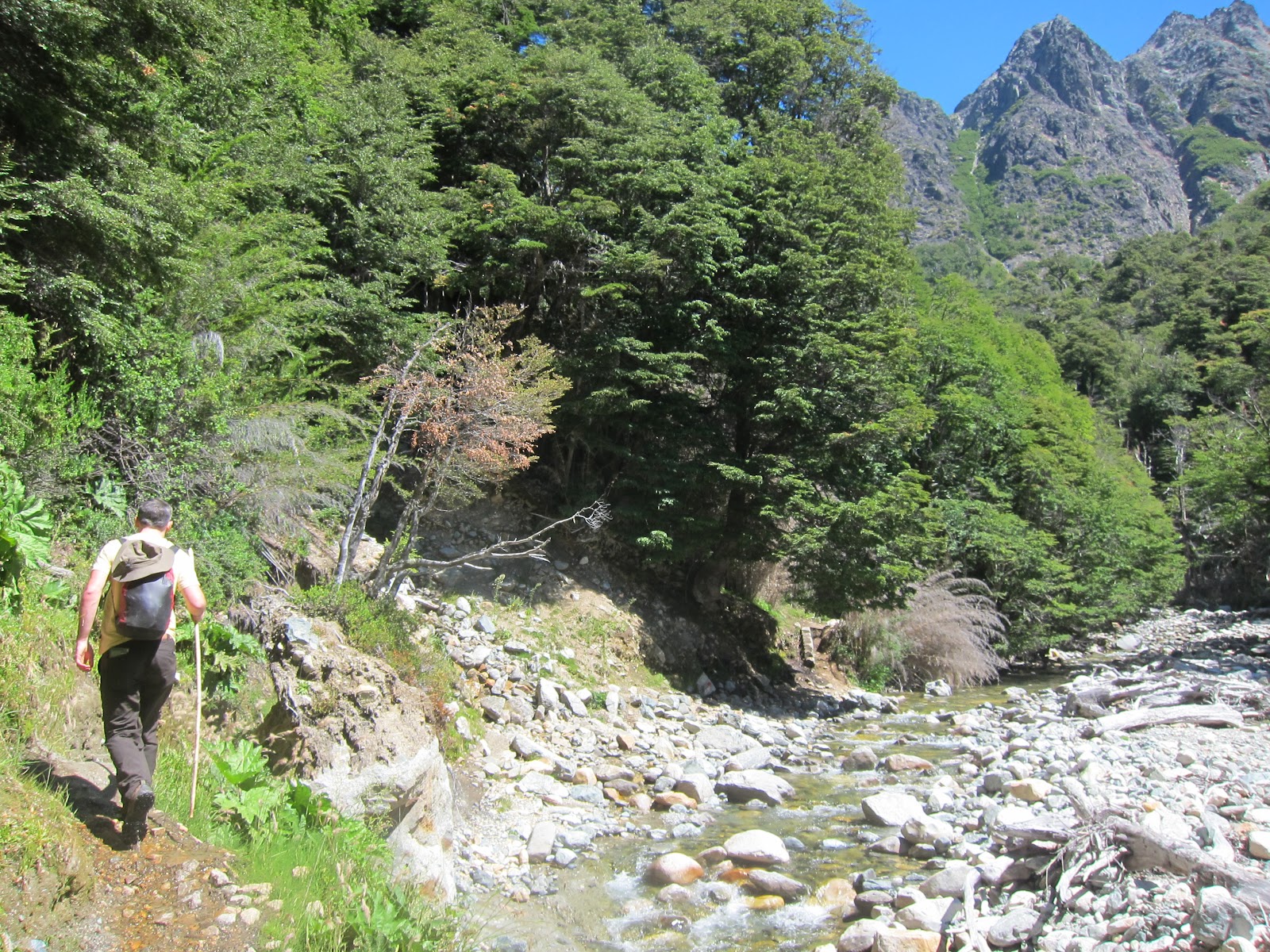
So, clearly words can't do this hike justice. Instead, here's a picture tour of that walk in the Andes.


The start of the trail

Mountains

Oh look! Furry little flowers!

Yikes. Not flowers. Tom's leg is all prickly now.